
For you

YOUR QUESTIONS
What are the consequences of converting American Depositary Receipts (ADRs) into common shares listed on the New York Stock Exchange (NYSE)?
The Board of Directors approved, at its meeting on September 24, 2025, the project to convert American Depositary Receipts (ADRs) into ordinary shares listed on the New York Stock Exchange (NYSE).
With this project, TotalEnergies is adapting to the evolution of its shareholder base, now strongly oriented toward North America. In addition, the conversion will remove frictions related to ADRs and foster access to additional assets under management (AuM) among institutional investment funds.
Accordingly, on October 30, 2025, the Company initiated the termination of the deposit agreement entered into between TotalEnergies, JP Morgan Chase Bank, N.A. (the depositary), and ADR holders, governing the ADR program.
Following this termination, each outstanding ADR was canceled and one ordinary share listed on the NYSE was delivered on December 8, 2025.
TotalEnergies SE remains a European company (societas europaea), registered in France, with its headquarters in Paris. The conversion does not affect the current listing on Euronext (Paris and Brussels), nor the Company’s structure or governance. Consequently, the Company remains included in major European indices, such as the CAC 40 and EURO STOXX 50.
The conversion therefore has no impact on French shareholders holding TotalEnergies shares listed on Euronext.

How many years of hydrocarbon reserves does the Company hold?
At December 31, 2024, TotalEnergies had a solid and diversified portfolio of proved hydrocarbon reserves of nearly 11,100 million barrels of oil equivalent per day (Mboe/d), for a reserves life index of 12.4 years, corresponding to an excellent reserves replacement ratio(1) of 157%. The Company’s proved reserves are established based on the rules of the United States Securities and Exchange Commission (SEC) with a Brent price of $81.17/b in 2024.
The reserves are located in Africa (mainly Angola, Mozambique, Nigeria and Uganda), the Americas (mainly the United States, Brazil and Argentina), Asia-Pacific (mainly Australia and Kazakhstan), Europe (mainly Denmark, Norway and the United Kingdom) and in the Middle East and North Africa (mainly the United Arab Emirates, Qatar, Iraq and Libya). Natural gas and related products (natural gas condensates and liquids) account for approximately 53% of these reserves and crude oil 47%.
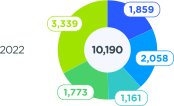
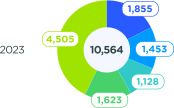
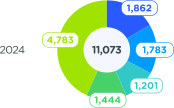
Hydrocarbon proved reserves(2) by geographic area (Mboe)
 Africa (excluding North Africa)
 Americas
 Asia-Pacific
 Europe
 Middle East and North Africa
(1) Variation of reserves excluding production: (revisions + discoveries & extensions + acquisitions - disposals)/production for the period.
(2) Based on SEC rules (Brent at $81.17/b in 2024, $83.27/b in 2023 and $101.24/b in 2022).